Michiganders and other people of the Great Lakes speak of a “Fourth Coast” –a coast of inland waterways, of vast glacial lakes and the passages between them. This watery network was a key to the continent for centuries before European explorers connected the dots across the Atlantic, roping Native Americans’ lake-borne economy into a global one. From the fur trapping era to the Second World War, Great Lakes shipping was a pillar of world trade. Even today, more than 100 freighters ply the Lakes, carrying iron ore, coal, limestone, steel, grain, and oddments such as mining equipment that are too awkwardly shaped and bulky to go by land.
The region’s oldest towns are old—decades past their tercentennials. St. Ignace (1671) and Sault Ste. Marie (1668) were both Jesuit mission towns, where French Catholic priests wooed Anishinaabe peoples to embrace Christianity. Both towns stand at crucial junctures: Sault Ste. Marie guards the passage from Lake Superior to Lake Huron, looking north-northeast across St. Mary’s River into Canada; St. Ignace faces south across the Straits of Mackinac, where Lake Michigan flows into Lake Huron. Under a thin mantle of fried fish, fudge, and souvenir shops, these towns tend an ancient geography of both the meeting of cultures and the meeting of waters.
I hadn’t been to either town since my tweens, but COVID wrought new travel choices. When my sister-in-law proposed a low-key, outdoorsy, extended family vacation in the eastern Upper Peninsula, I jumped at the chance. I grew up in Michigan—downstate and well inland, but nonetheless singing socialist sea chanties about iron ore shipping strikes in music class. No place in Michigan is more than 85 miles from a Great Lake, and even those from inland towns feel the Lakes’ splashing, bracing pull.
Getting to the Upper Peninsula from the East Coast, where I now live, can be a challenge. There are plenty of airports, but only a fraction of them have regularly scheduled commercial flights, one or two a day from Detroit, Chicago, or Minneapolis. Connections can be painfully tight, and complications slightly bizarre. On a previous trip to visit my brother, the small commuter jet on which I was traveling made an unscheduled touchdown in Traverse City because the pilot had suddenly decided that the runway at Marquette was too short. Now, as any Yooper knows—and as my perplexed brother immediately remarked by text—Marquette is a former Air Force base with a dizzying expanse of runway that can, if need be, accommodate 777s. It would be too short for the space shuttle, but not for much else. One of the flight attendants made coffee while someone explained this to the pilot.
This time, I deliberately flew to Traverse City, in the upper Lower Peninsula. My mother picked me up and drove the last couple hours past the cherry orchards and over the longest suspension bridge in the Western Hemisphere into the U.P. By mid-afternoon we arrived in St. Ignace, a ribbon-like clutch of restaurants, motels, and residential cul-de-sacs strung along H-63 like mismatched beads on a string. The town has a population of a little over two thousand souls, about the same as it had three hundred years ago, when it was a trading hub for the Odawa, Ojibwe, Huron, and French in a landscape crafted around water.
Today a museum of Ojibwe culture stands on the site of the old mission. Father Jacques Marquette lies buried outside. A great traveler, among the first Europeans to meet the Illini people or see the Mississippi River, he died in the Lower Peninsula, near Ludington, in the course of his travels. Native friends brought his remains northward a few years later and reinterred him at the mission he founded; in 2022, he was reinterred again with an Anishinaabe pipe ceremony and a bicultural feast. Anishinaabe culture is quietly visible in St. Ignace, where more than a quarter of the population identifies as Native American. A replica migration chart, on display in the museum, traces the historic Ojibwe migration from the Atlantic to Minnesota via the Great Lakes; the Mackinac Bands of Chippewa and Ottawa, related Anishinaabe peoples with deep roots around the Straits of Mackinac, are headquartered here.
Sault Ste. Marie, fifty miles northeast of St. Ignace, has always been a rougher meeting of the waters. The French term “Sault,” meaning “jump,” evokes the rapids on St. Mary’s River, the narrow passage between two Great Lakes. There is a 21-foot drop from Lake Superior to Lake Huron, rendering locks a necessity. The first set was built on the Canadian side in 1798, for freight canoes; U.S. forces destroyed them in the War of 1812. The first set on the American side was built in 1855, facilitating the shipment of freight from Duluth, Minnesota, all the way to the Atlantic. The locks in operation today, the Poe Lock (constructed in 1896 and reconstructed in 1968) and the MacArthur Lock (1943), handle 7000 lockages over each 42-week shipping year.
The Soo Locks are first and foremost a working site, with a slight industrial feel. Tourists fit themselves in around the edges. We stood on an open-air viewing platform, in a small crowd of Amish families and shipping enthusiasts, and I watched my adolescent niece and nephew watching a 1000-foot freighter come through. Rain began to fall, and I shivered desperately in shorts and a cotton sweater. It was the last week of June. Soon I took refuge in a visitor center with poster boards and dioramas so entrancing that I whipped out a notebook and started taking notes. A third lock, I learned, is due to open in 2030.
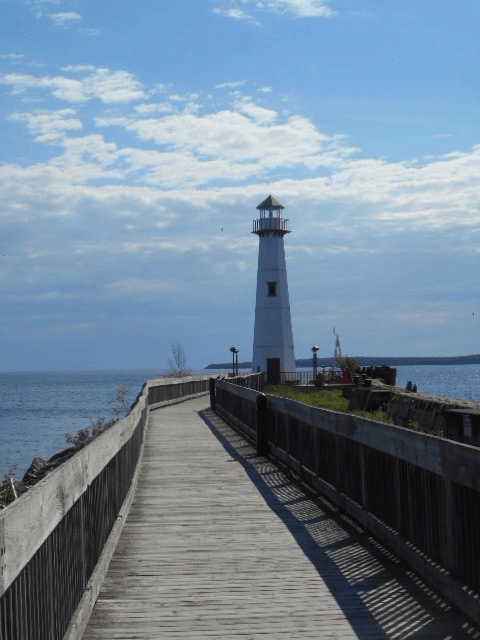
Great Lakes shipping is a mighty tradition, but it has always come at a cost. At Whitefish Point on Lake Superior, a notorious trouble spot, the Great Lakes Shipwreck Museum plays “The Wreck of the Edmund Fitzgerald” on an endless loop. The first lighthouse on the Great Lakes was built here, at Whitefish Point, in 1849. At the time, it was a focus of national interest; New York City newspaperman Horace Greeley editorialized that sending men on the Lakes without a lighthouse amounted to “virtual manslaughter.” The original light burned sperm whale oil. One of the livelier episodes in the history of Whitefish Point was the 1918 arrest of the lighthouse keeper and his wife as German spies; they had been assigned to scramble Great Lakes shipping and thereby hamper the U.S. war effort. Remote as Lake Superior may feel, what went down there had global implications.
Perhaps that should be in the present tense. The lighthouse at Whitefish Point, like most on the Great Lakes, was automated in the 1970s, but it’s still in active service. The life of the Lakes continues.
Michiganders joke about how slow the Upper Peninsula is. Sault Ste. Marie, with a population firmly in five digits, is what passes for a metropolis here. Amish horses stand patiently in parking lots. Cars break for foxes and occasionally moose. Fudge is for sale every day and everywhere, because in the snack shops, it is always 1910. St. Ignace has a coffee shop that prepares Michigan-themed espresso drinks such as the maple-infused One-Eyed Jack and Da Yooper Latte, but this burst of creativity serves mostly to underline how novel espresso beverages still are north of the bridge. Sightseeing in St. Ignace consisted in part of sitting on the motel balcony, staring out at Lake Huron and debating each ship’s movement or lack of movement with my mother.
But slow is not stationary. Visiting the towns that rim the Lakes appeals precisely because the waterborne economy still lives and breathes. Many people don’t realize it until they get here, but this is one of our national arteries. Watching Great Lakes shipping is like peering into the subterranean maze of wires, pipes, and tunnels we all depend on for energy and water, or peering into the ligaments that structure the human body. All of the region’s tales are tales of movement, from the Ojibwe migration chart at the St. Ignace museum through to the nineteenth-century dramas of building locks and lighthouses and the ongoing freight traffic today. The pace is slow but rhythmic and determined, a splashing pull of water.

